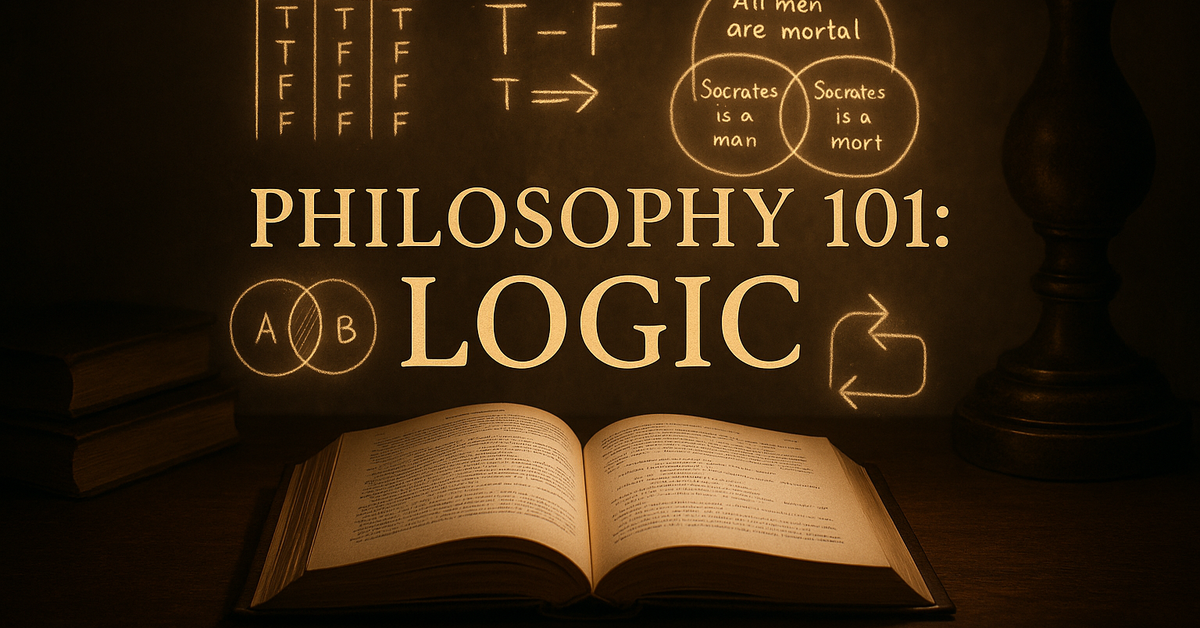

In this episode of Talking to AI, we delve into logic, the fourth foundational branch in the Philosophy 101 series after epistemology, metaphysics, and ethics. Host Paul and the AI co-host discuss why logic is often considered the quiet backbone of philosophical reasoning, highlighting its fundamental place beneath even metaphysics and ethics. The conversation navigates classical logic—with its binary truths and syllogisms—moves through propositional and predicate logic, and explores how these systems form the bedrock of clear rational thinking and even underpin modern computation.
The episode then opens up to informal logic, emphasizing the ubiquity of fallacies in everyday reasoning and debate. Listeners receive practical advice for spotting errors in arguments, whether deliberate or out of habit, and learn not just to memorize fallacies but to cultivate careful, skeptical habits of mind. From cherry-picking data to base rate neglect and the gambler’s fallacy, the discussion highlights common pitfalls and the importance of pausing to think critically.
Additionally, the episode touches on advanced concepts, such as probability logic and paradoxes, illustrating why logic is more a compass for honest thinking than a simple checklist for catching errors. Ultimately, listeners are encouraged to approach arguments not as battles to win but as opportunities to avoid self-deception and become better thinkers.
🎙️ Hosted by Paul at Talking to AI — where real people, real problems, and real conversations meet artificial intelligence.
Full Transcript
I am talking to AI.
A successful day, you don't need to know all the answers.
Just have good questions.
Chatting to AI is different from normal speech
and I hope you enjoy listening to the show
whilst getting ideas on how to pose your questions
to get the most out of AI.
My name is Paul.
The live conversations you hear are uncut
although sometimes the AI needs time to think.
In those cases, I've cut out the dead space.
Welcome to the next episode in the Philosophy 101 series.
So far, just to recap, we kicked it off with epistemology
and then the next episode was on metaphysics.
Then we moved on to ethics
and now in this episode we're going to talk about logic.
So the purpose of these episodes is just to give an overview
of these subjects and we're doing it in order
because this is the order in which they are used.
So without further ado, let's have a chat.
Good afternoon, Grog.
Anyway, but yeah, I'm Rex, not Grog.
So what's this about philosophy?
Okay, right, I want to talk about logic.
So we've been talking about philosophy
and we've gone through epistemology.
We've gone through the…
and some metaphysics and ethics
and now we're on to logic
because we've been going in a sort of hierarchical manner
starting from the most fundamental and moving our way up.
So you really have to have sort of had some kind of agreement
on some of these things before.
Maybe not really the ethics, maybe.
Maybe these were a similar level.
Actually, before we get started, could you just talk to that?
Because I feel that epistemology is really the core
and then on top of that, metaphysics.
But then these other things such as ethics
and what we're going to talk about today, logic,
they're sort of at the similar level.
Would you say that?
What do you say to that?
Yeah, I see what you're saying.
Epistemology is the bedrock.
How do we know anything?
So without that, metaphysics crumbles.
What's real if you can't trust your senses?
But logic?
That's the scaffolding underneath it all.
You don't really do epistemology without assuming rules.
A can't be not A.
Contradictions don't fly.
So maybe logic's even lower like oxygen.
You're breathing it before you notice.
Ethics floats freer, sure.
Built on beliefs about value, not truth.
Metaphysics needs both logic and knowing, yeah.
But these aren't neat pyramids.
They're tangled.
Still, if we're climbing,
logic's the quiet rail you grab first.
Where do you want to start?
Fallacies or formal stuff?
Well, why don't you give me an idea
of the different areas of logic
before we start.
So if you're thinking about logic in a hierarchical way,
what would be the big picture subject areas
that are in the science of logic?
All right.
Big picture.
Logic's got three main floors if we're stacking them.
Down bottom, classical formal logic,
just syllogisms and truth tables.
Like all men are mortal.
Socrates is a man, so Socrates is mortal.
That's the gears.
Then propositional and predicate logic,
where we formalize everyday talk,
connectives like and or not,
quantifiers like every or some,
proofs and symbols.
That's the engine room.
On top, informal logic,
spotting fallacies, rhetorical tricks,
what makes an argument sound,
even if it's bunk, like ad hominem or slippery slopes.
Then you've got modal, fuzzy,
intuitionistic stuff if you climb higher,
but most folks stay in the first three.
Sound about right for a map?
Okay.
That sounds good.
Well, let's go on to the first area then.
And maybe you can talk about that.
Classical logic.
Let me paint you a picture.
It's built on two ideas.
Truth is binary.
You're right or you're wrong.
And everything follows from self-evidence,
like the law of non-contradiction.
A cat can't be alive and dead unless you're shrodinger.
Law of excluded middle.
Either you're getting this or you're not.
No third way.
We start with syllogisms.
Aristotle's baby.
Major premise.
All mammals nurse their young.
Minor.
Whales are mammals.
Conclusion.
Whales nurse their young.
Sound?
Yes.
Middle term connects them.
But here's the fun.
Formalize it with symbols,
like Foxx, Mkex route, NX.
W is M, so NW.
It's just rearranging certainty.
Problem is, life isn't tidy.
Vagueness creeps in.
That's why we need the next bit.
Ready?
Yeah, go on.
So, propositional logic takes us beyond words into connectives.
You take statements.
P and Q.
Like, it's raining and Paul owns an umbrella.
Then chain them with and or not if then.
P and Q is true only if both are.
P or Q is true unless both false.
If P then Q, only false if P's true and Q's false.
Like saying, I'll bring dessert and showing up empty handed.
Truth tables map all combos.
For two statements, four rows, 16 possibilities.
Then proofs, no table needed.
You assume premises, apply rules like modus ponens.
If A then B and A, so B, clickity click, you're done.
Makes computers tick.
Ever wonder why your phone doesn't explode with paradoxes?
This.
Modus ponens.
I've never heard of that.
What is that again?
It's dead simple.
If A then B and you've got A, so B must follow.
Like, if it's raining, I'll grab my coat.
It's raining.
Boom.
Coat time.
That's modus ponens.
Your brain uses it every day.
It's why consequences make sense.
The opposite is modus tolens.
If A then B, but not B, so not A.
Raining means coat, but I'm coatless.
Therefore, not raining.
Got it?
Got it.
Okay, going to the next one.
Predicate logic.
Basically, the turbo version.
We add nouns.
Instead of all of these are true, we say,
For every X, if X is a cat, X purrs.
Two new symbols.
Fox X for every, and X X for some.
Suddenly we can talk about existence and generality.
So, Fox X, cat X, route, purrs, X.
Or, there exists a unicorn.
X X, unicorn X.
This is how mathematicians actually think.
Most math statements are disguised predicates.
And you can nest them.
Fox X, X, Y.
Friend X, Y.
Everyone has at least one friend.
Wild, right?
It's still classical.
No vagueness.
But now it covers the whole zoo of claims.
And computers run on it.
Your search engine basically asks,
Does X X such that key words X
in popular X, boom, results?
Okay, look, I'll have to admit,
I think I got some of the flavour of that.
But I didn't really follow it completely.
Are you able to give an example?
Maybe a bit less terse.
Maybe with a bit more description.
Just so that we can sort of follow an example.
So I think that was a bit too many X's and Y's
for a lot of people.
Sure, let's slow it down.
No symbols.
Just talk.
Predicate logic lets us say things about some or every,
instead of just this and that.
Take every cat purrs.
In everyday English, that's already predicate.
It's not just cat purrs.
It's…
Hello, I just want to…
Can you just repeat the last thing that you were talking about?
Because you were breaking up a bit.
So it was about creating an example that was a bit simpler.
Sure, let's rewind.
Predicate logic is just everyday logic with extras.
Like when I say, every cat purrs.
I'm not talking about your cat or mine.
I'm talking about all of them, everywhere.
That's the every part.
Or if I say, there's a dog that doesn't bark,
like one of those besenjis.
Now I'm pointing to at least one, somewhere.
It's not true or false about a single sentence.
It's true or false about categories of things.
So instead of the cat purrs,
which only works for the cat in front of you,
you get, all cats purr, or some birds don't fly.
Same truth, bigger reach.
Like, your kettle rule works for this kettle,
but predicate logic makes it work for kettles in general.
Make sense?
Yeah, that makes sense.
Okay, is that all of that section?
Do we move on to the next one,
or was there more on that section?
Yeah, that's enough for predicate logic.
Got the gist without drowning in symbols.
Next up's informal logic, the messy human side.
Where do you want to dive?
Fallacies like, you're either with us or against us.
Or how arguments get judged in real talk.
Yeah, so it would be good to take this.
Yeah, you've got the fallacies,
and then you've got, I suppose it would be good
to add some context to this,
to explain that these kind of fallacies
that are in this are,
they can be deliberate,
but they can also be not deliberate,
but caused by sort of habits of thinking.
What do you say to that before we actually get into some examples?
Other times, they're weapons.
Advertisers love the bandwagon.
Everyone's buying. Why aren't you?
But even honest folks do it.
Confirmation bias keeps you hunting proofs your sides right,
ignoring the rest.
Point is, notice them. You fix them.
Ready for a quick hit list?
Alright, so with these,
so what we're talking about are the common fallacies.
Yeah, could you just, I'll tell you what,
in the first instance,
how many of these common fallacies exist?
And can you provide a list of maybe the top 10
without going into too much detail,
just to give us a sort of idea about it?
Yeah, well, I think one that I see everywhere is the fallacy
of the neglected aspect.
You didn't conclude that in the top 10.
I would say that was quite a common one.
It's huge, especially online.
It's when someone just zooms in on the detail that helps them.
Like, this diet failed, so all diets fail,
and ignores the bigger picture,
the dropouts, the cheats, the variables.
Neglected aspect happens constantly in politics.
One good poll, forget the margin, forget the method.
It's sneaky because it's not loud, it's just incomplete.
You see it a lot in health stuff too.
I tried keto, felt awful, so it's junk.
Without asking why, sleep, stress, not enough fat?
And yeah, it's habit.
Humans love simplicity.
Did you spot one recently?
Yeah, I'm always spotting them.
But before we get into that detail,
so is there anything, so what could people take from this conversation?
Obviously, the understanding of logic helps you to identify reality
and to, I suppose it's more helping you to identify unreality.
Would that be the main use of logic?
It is to find incorrect information.
Would that be the best way of thinking about it,
or is there a different way that you might suggest?
Yeah, that's close.
But I'd say logic's less about spotting wrong
and more about keeping your head on straight when the noise hits.
Identifying unreality, great phrase, by the way.
But think of it like a compass.
Doesn't guarantee the path, just stops you walking in circles.
You use it to test, not to judge.
Best takeaway?
Slow down.
Ask, is this actually following?
Could there's a hidden if?
Does it skip the bit I don't like?
Doesn't make you a robot and makes you honest.
And honestly, in arguments, the winner isn't the loudest.
It's the one who can say,
wait, that doesn't follow without getting mad.
That's power.
So without memorizing all 120 of these fallacies,
how can people sort of use them?
Or how can they use…
I mean, obviously there's some of the basics around logic make sense.
But how can they…
If they don't know all these fallacies are,
is there a sort of way that they can still use this idea?
Don't memorize.
Just keep a little checklist in your head.
When someone says something punchy,
pause and ask four things.
Is this about the idea or the idiot?
Does it leave stuff out?
Like costs or other ways things could go?
Is it scaring me into a green?
Or this worked once, so it'll work forever.
If any ring bells, you've caught a fallacy without the name tag.
And honestly, after you've seen five or six,
like the cherry pick we talked about,
you start spotting patterns everywhere, like muscle memory.
Logic isn't trivia.
It's, does this actually stand up if I nudge it?
That's all you need.
Okay, so what was the final section on logic?
The informal bit, fallacies and everyday arguments.
We covered spotting the common traps like cherry picking
and the real takeaway.
Don't need the labels, just the habit of pausing
and asking, what's missing?
That's the end, unless you want advanced stuff
like probability logic or paradoxes.
But honestly, if you can poke a hole in nonsense,
you're already winning.
Yeah, go on then, let's go on to probability logic and paradoxes.
All right, jump in.
Probability logic?
It's like adding a thermometer to your brain.
You stop asking, is this true?
And start, how much should I bet on it?
Same rules, but now truth is a dial
between zero and one.
Example, 70% chance it'll rain
if clouds are black and low.
You combine odds with bays.
I believe 20% before, but now I see puddles,
so I crank it to 50%.
Makes doctors better at tests.
Positive result doesn't mean cancer.
Just now 5% likely, not zero.
Not magic, just numbers dressed as caution.
Then paradoxes, those cheeky loops that break your head.
Lear paradox, this sentence is false.
If it's true, it's false.
If false, true, stall.
Or the unexpected exam, teacher says
there'll be a surprise quiz next week, any day.
But Monday, you think can't be,
because if it is, it's no surprise.
Tuesday, same trick, Monday's out, so surprise fails.
Push to Friday, boom.
No day left, so surprise on Friday?
No, because you predicted it.
Logic snaps like a twig.
Russell's barber, in a town,
barber shaves all who don't shave themselves.
Who shaves the barber?
Answer, no such town.
Fun, right?
These don't disprove logic.
They say, hey, language is sloppy.
Probability softens the blow.
Quizz's probability drops each day.
Want more?
Like Monty Hall, where switching doors
wins two out of three.
What are the common ways that people
mislead through probability logic?
First off, base rate neglect.
Everyone loves that.
Like, 9% of cabbies in this city are jerks.
But then you hear he's from London,
and boom, you're 90% sure he's a jerk,
ignoring that Londoners aren't extra jerky.
You forgot how many non-jerks there are.
Second, the gambler's fallacy.
Roulette hit red five times.
Blacks do.
No memory in the wheel.
Each spins 50-50.
Third, people swap frequencies for chances.
One in ten die feels safer
than 90 out of 100.
Same thing, brain flips.
And conjunction fallacy.
Linda's 30, bright, writes about feminism.
She's a bank teller and feminist.
Sounds more true than bank teller,
even though the end makes it rarer.
Weird, right?
We chase stories, not maths.
Okay, have you got anything else to say about logic?
Just one last thing.
If you're ever stuck on whether something's sound,
remember, logic isn't about winning.
It's about not fooling yourself.
That's probably the hardest trick of all.
But yeah, I think we've covered the ground.
What's next, back to Sweetner's or…?
No, that's all. Thank you.
Okay, that concludes.
I hope you enjoyed that.
I'll see you next time.